Showing posts with label Women and Love. Show all posts
Monday, September 6, 2010
The most popular playwright of the Restoration
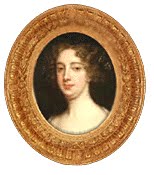
APHRA “ASTREA” BEHN
Any day that she saw light, she read,
Pleased by the words that brought
Her a studied imagination
Royally bent toward the king.
A Tory she was and said,
“As you think, so shall you be.”
She thought she was equal any man
That wrote a line and showed her
Regal master the scripted play.
Every day was a turning point
And a validation for all women
Bent to will of patriarchies,
Even those of court and common.
Her legacy was that all were
Noble in possibility and reach.
--April-May, 2009
"Aphra 'Astrea' Behn" is an acrostic poem, one in the series about women, especially those who had to fight for recognition in a male world. These are collected in the unpublished Women and Love. When I first discovered Behn, I was quite annoyed that she had not been presented in any of my undergraduate courses. I read her play The Rover, or The Banish'd Cavaliers (1677) and enjoyed it. Like the Elizabethan playwrights, those of the Restoration wrote under the glow of a monarchy and wrote with it in mind. They enjoyed puns and tropes and schemes as much as the Elizabethans. Of course, she can't compare with Shakespeare (Who can?), but she is comparable to the other playwrights.
Aphra Behn served as a spy for England during the war with the Dutch. She also wrote many poems and Oroonoko: or, the Royal Slave (1699), one of the earliest novels in English Literature. Most of its main characters are black, and the narrative takes them from African royalty into slavery for the Europeans in the New World. It is also a love story of loss, separation and rediscovery.
From what I have discovered, Aphra lived a bisexual life freely and openly, although she seemed to prefer women to men. The Victorians could not abide such gender bending and shut her out of their canon of literature; therefore, her fame languished until the women's movement of the 20th century.
Below are items related to this blog.
Sunday, August 29, 2010
Young, black and enslaved
Phillis Wheatley
Phoebus remained her true god, the flambeau brought with
Her from Africa when she was ten years old.
In the dark of slavery, she was—without a doubt—
Lucky, for her master nurtured the flame of curiosity;
Lucky, for her Boston family illumined her—
In the home—with the edification of the word,
So she bloomed as a bright and reflective
Writer. Her poems sparkled with light.
Her poems illuminated those who read them.
Even Washington, warmed, beckoned her to Mount Vernon,
And she came and they talked unto emblazonment.
Then, after that talk, he allowed black soldiers to be
Let to serve their country, and at death, he freed his slaves.
Everything did not stay sublime: her husband passed, so darkened her last
Years of toil; she died only thirty-one.
2010
"Phillis Wheatley" is an acrostic poem. She is the beginning of African-American literature. What I really enjoy about her story is how her bright intelligence put to lie the idea that black people were inherently inferior, convincing the father of our country that someday we all would truly be equal.
Below are items related to this blog.
Sunday, July 11, 2010
the romantic illusion
A ROMANCE
I imagine the first glance:
Quick like the eye of a bird,
Moist like a deer’s
Expectant like a child’s
Full of wonder and curiosity, newborn.
I imagine the first closeness:
The furnace of your body palpable,
Your hair lightly visible around your breasts,
The slight perspiration over your lips, slightly parted
Like a waiting door, fresh painted.
I imagine the first words:
Intense breath and mellifluous
Vibrating from your lips,
Flowing, flowing in waves,
Washing my mind like the ocean
Rinsing the shore, redolent with life and expectation.
I imagine the first touch:
Your skin smooth against mine,
Your cheek brushing mine softly,
Your fingers playing enchantments on my wrist,
Your hair falling like a net lured
With promises, sparkling in sunlight.
I imagine the first kiss:
Hot, soft, pressing and drawing me
Simultaneously, spontaneously
Into your embrace, into the core of the furnace,
Into your wild and full self,
A drowning into the pool of firsts and forevers.
Published in the Tampa Bay Review, Fall 1989
I wrote this poem on a dare. At the time, I was working as an academic dean, and a female teacher who was married to an unfaithful man began flirting with me. I was in a committed relationship and had no intention of doing anything, but I was sympathetic because of her situation. She asked me to write a poem about love. I wrote this, but it is a stealth poem because although it seems to be about romatic love, it is a deception. The title "A Romance" if read carefully is the opposite of romance just as amoral is the opposite of moral and abnormal is the opposite of normal.
If not read carefully, each stanza seems to encompass a step into romantic love, but the first words of each stanza are I imagine, so nothing is really happening; it is all imaginary. The final line, A drowning into the pool of firsts and forevers, is a final assessment of "a romance." What rational human wants to drown in anything? A drowning is an excess, an overdoing, and can mean the end of everything. A pool is a collection; it can be a collection of water, but it can also be a collection of experiences--in this case romantic experiences. The implication is that once again, but for the first time with each new lover, will come the enveloping romantic love in which one becomes infatuated with love itself, so one speaks in "perpetual hyperbole."*
*Perpetual hyperbole is from Sir Francis Bacon's essay "Of Love."
Having revealed my thoughts about romance, I can still enjoy love narratives and poetry. Here are some of my favorites (most of these have been made into movies) :
Thursday, June 3, 2010
Veronica Franco Casanova Heath Ledger
Verily, verily these be the courtesan verities
Etched upon the flexible woman’s brow—
Reality as brutal as all other fealties.
Out of Venice, she brought as a woman now,
Not man, might bring these things to light
Incandescent as a burning bow,
Curtsy or genuflect in the breadth of night—
Anthems for women in which to believe
For dangerous darkness or dreary daylight.
Romances about beautiful life she could weave
And print them and read them and boldly shine,
Not abed necessarily, nor nursery bereave,
Chatting with the best minds line by line,
Owner of her world with a presence fine.
4/26-5/11/2009
This acrostic poem has not previously been published. Veronica Franco is another amazing woman who lived in a time when women's minds were not valued. She was a poet and literateur. In the recent movie Casanova
Since she was a poet, the acrostic devoted to her also rhymes (ababcbcdcdedee) and has fourteen lines as does a sonnet. During her time, rhymed sonnets were common.
Tuesday, June 1, 2010
Georgia Okeeffe Taos Lee Ware
GEORGIA O’KEEFFE
Gorgeously artistic mind she had, so
Each time she spied a view—it was new,
Opposed to what she had been taught.
Rigorously focused more finely than a camera,
Gloriously deft eye she had—so
Indisputably hers—that her strokes seemed
As if she had merely swallowed a petal, and
Out of her it reappeared for us all to see.
Knowledge of light and line were there, too,
Exhibited to the world (by her spouse).
Enviously, we saw how seeing as she saw
First, made us second to the fine eye and
Fine hand that ever steadily drew us into her
Ever finer, ever greater, artistic universe.
This acrostic poem has never been published before now. I wrote it in 2008. Okeeffe has long been one of my favorite artists. I have visited Taos, New Mexico, and seen her home and many of the buildings she painted--and vistas, and flowers, and plants. I admire her person as much as I admire her paintings, for she was as true to her person as her art. One of my favorite birthday gifts was a book of her paintings, given to me by Lee Ware, who understood my soul as much as anyone ever has. The book was titled Georgia O'Keeffe, A Studio Book and was published by Viking Press in 1976. I haven't been able to find it on the Web, so it is probably out of print.
Follow this link to buy prints of her paintings. Georgia Okeeffe
Sunday, May 23, 2010
Kate Chopin The Awakening

This is the orginal cover of her novel. You can order the current version by clicking on the link below.KATE CHOPIN
Kindred spirit to Artemisia and Frida was Kate, who battled men in a man’s world,
As if she could play the patriarchal game, when all the while she suffered the
Torments of the specially gifted differently to see the illusions of the world as she
Eluded the stereotypes of wife and mother, although she was both, and
Created her truer world of Creole and Cajun denizens of real desires and
Hopes of all places and all times. She wrote so people could understand if
Only they would read and learn how women yearn to be another unique
Person, just that and nothing more, a flesh and blood and nerve and mind
Individually wrapped, but sensing the universe and all its possibilities
No more nor less than any other homo sapiens that ever trod the earth.
June 2008
This acrostic poem was first published in Creative Woman, Miami Dade College, 2008; and subsequently in the Ann Arbor Review, Fall 2009.
Saturday, May 22, 2010
Edith Piaf La Vie en Rose
EDITH “LA MOME” PIAF
Every time she sang, people stopped: their work, their worries, their
Disappointments, their meals, and gave her their ears. O, Chanteuse!
In Paris, she was a little throbbing sparrow with a huge voice
That crooned, “I am singing about you—this place and this time—forever.”
How did such a tiny vessel ring with such a full tone?
“La Mome” knew their hearts, knew their souls, carried their torch,
And all who heard her caught the flame that seared them.
Many would start, clasp their hands, and gaze at the enchantress
Out of whose mouth their mysteries and secrets were revealed.
Many, listening alone to a radio, would feel their lips quiver, sense
Each tear that trickled down their cheeks, sigh and
Peek out a window at the City of Lights, city of art, city of
Iniquities, city of failing empire, city of humiliation.
As she sang “No, Je Ne Regrette Rien,” all the denizens knew she knew
Full well their strengths and weaknesses and loved them despite their faults.
This acrostic poem about another creative woman who suffered for her art was first published in Creative Woman, Miami Dade College, 2008, and subsequently in the Ann Arbor Review, Fall 2009. I recommend the movie La Vie en Rose about Edith Piaf. It's a wonderful rendition of her life and art. Click here to order: La Vie en Rose
Thursday, May 20, 2010
Artemisia Gentileschi
Artemisia Gentileschi by Mary D Garrard Order this book about Artemisia.
ARTEMISIA GENTILESCHI
As a woman, she learned that in a baroque
Renaissance she was not less proficient
Than a man, in fact, just as good stroke-for-stroke in each
Endeavor—canvas by canvas—that she undertook.
Men—those lying devils—were not, not
Including her father Orazio, to be trusted,
Should not be believed. They bruited falsely.
Instead, she followed her own golden thread.
Ahead of her time, she would take (like Clio and Minerva)
Great strides, paint greatly the tropes of
Each dream that would in a Medicean terrain
Not leave the orbit of her mind, that would
Take over her Roman spirit, that would
Inculcate within her a desire, a drive, to
Live the artistic life—courtly and ecumenical—despite
Every offense given her—rape, neglect, abuse—by those
Single-minded, lazy, self-indulgent, brutish
Curs that sniffed around her chiascuro.
Her dream grew in perspective with her visual
Intelligence and skillful hand—innately hers.
This acrostic poem was first published in Creative Woman, Miami Dade College, 2008; and subsequently in the Ann Arbor Review, Fall 2009. This female artist was overlooked until the 20th century.
Tuesday, May 18, 2010
Miami International Film Festival
1
My dream was seeing your grace and charm,
your acrobatic hands,
your lithe form twirling,
so the diaphanous dress rose
like a cloud
or a butterfly.
You floated above us the dumb audience,
rendering a dance so composed
as if
you did not live
for applause
but only
for the dance.
2
Earlier in rehearsals I had seen you not
speaking, not
exclaiming, but
listening with your eyes
as your choreographer directed
with her hands your every movement:
a lift,
a dip,
your hands fluttering like the wings of birds
in flight,
rising on air,
your form embracing the curve of the earth
and buoyant as the sky.
3
Up close, your face was luminous
as the moon in early spring.
Through your lunar eyes,
you tried to understand the silent throng
of aliens
that smiled, clapped and bowed—
and had photos taken beside your gift.
You true artist,
who would have danced
in a blind forest,
so only the wild creatures could have fallen in love,
I blow you a kiss
because I know neither of your tongues—
Chinese
or your supple
arms,
hands and
fingers.
3/2-12/08
I wrote this poem after seeing a deaf Chinese dancer perform with amazing grace at the Miami International Film Festival 2008. The poem was published first in Creative Woman, Miami-Dade College, 2008.
Subscribe to:
Posts (Atom)


